Vision and identity
Code: backend/src/justai/vision/, backend/src/justai/identity/, models through the
plugin vision-opencv.
Pipeline (resource-saving)
Section titled “Pipeline (resource-saving)”go2rtc substream ─► ffmpeg (fps per camera, default 2) ─► privacy mask ─► motion detection ─► object detection YOLOX – only on motion, active tracks or every heartbeat_s (20 s) ─► IoU tracker (per class, time-based ageing) ─► face check YuNet + SFace on a full-res snapshot – only for still unknown person tracks ─► events · sightings (DB) · watches · PTZ tracking listener- One detector and one face model for all cameras, inference in a limited thread pool (2 workers).
- During conversations the background frame rate drops (
background_slowdown). PTZ tracking switches on the analysis of every frame for its camera. - Rooms with
vision_allowed: falseare not analysed; withface_recognition_allowed: falsethere is no face recognition there.
Configuration per camera
Section titled “Configuration per camera”Admin UI → Vision (PUT /api/vision/cameras/{device_id}), or by voice for on/off
(“Stop analysing the living room camera”, tool vision.analysis):
| Field | Default |
|---|---|
enabled |
true |
fps |
2 (0.2–10) |
motion, objects, faces |
true |
labels |
person, dog, cat, car, truck, bicycle, motorcycle, bird |
min_score |
0.5 |
privacy_zones |
polygons (normalised coordinates); blacked out before every analysis |
heartbeat_s |
20 |
A camera in privacy mode (“switch off the camera in the bedroom”) delivers no image; the analysis pauses until it is switched on again.
When does somebody count as “seen”?
Section titled “When does somebody count as “seen”?”The object detector only runs on motion or every 20 s. If somebody sits still, their track breaks between two runs (after 4 s without a hit) and is recognised again shortly after. Therefore:
vision.person.recognizedis reported at most every 2 minutes per person.- The event contains
away_s: seconds since the person was last identified on any camera (after a restart from the stored sightings; never seen = one year). This lets automations distinguish “came back” from “sat there all the time”.
Events
Section titled “Events”vision.motion.started/ended, vision.object.appeared/left, vision.person.recognized
(biometric, high priority), vision.face.unknown, vision.watch.triggered,
vision.state.changed.
Tools for the assistant
Section titled “Tools for the assistant”| Tool | Purpose |
|---|---|
vision.look |
snapshot of the camera in the room (or a named one) to the vision model: “What do you see?” |
vision.detect |
local object detection on the current image |
vision.where_is |
last sighting of a person/pet/object (from the sightings) |
vision.watch / vision.unwatch |
watch task: “Tell me when a car drives into the driveway” (optionally time-limited). When triggered, an announcement in the room where the task was given, in the language it was given in. |
vision.state_teach / vision.state_get |
learnable states (“The garage door is open now”), see below |
vision.search_area |
search an area with a PTZ camera (PTZ.md) |
vision.analysis |
switch the image analysis of a camera on or off |
Images only go to cloud models if the privacy rules allow it (camera_images_to_cloud
globally and cloud_media_allowed in the room). Otherwise a local vision model from the
role vision is used or the request is refused.
Learnable state detectors
Section titled “Learnable state detectors”For fixed cameras: a detector watches a region (e.g. the garage door). The user shows
examples by naming the current state; several references per state are possible
(day/night). Classification is a nearest-neighbour comparison on normalised, scaled-down
greyscale crops. It needs no training and no new code. State changes create
vision.state.changed and can trigger automations.
Limits: strong light changes without a matching reference lead to wrong states. So create references in different light conditions.
People, pets, faces
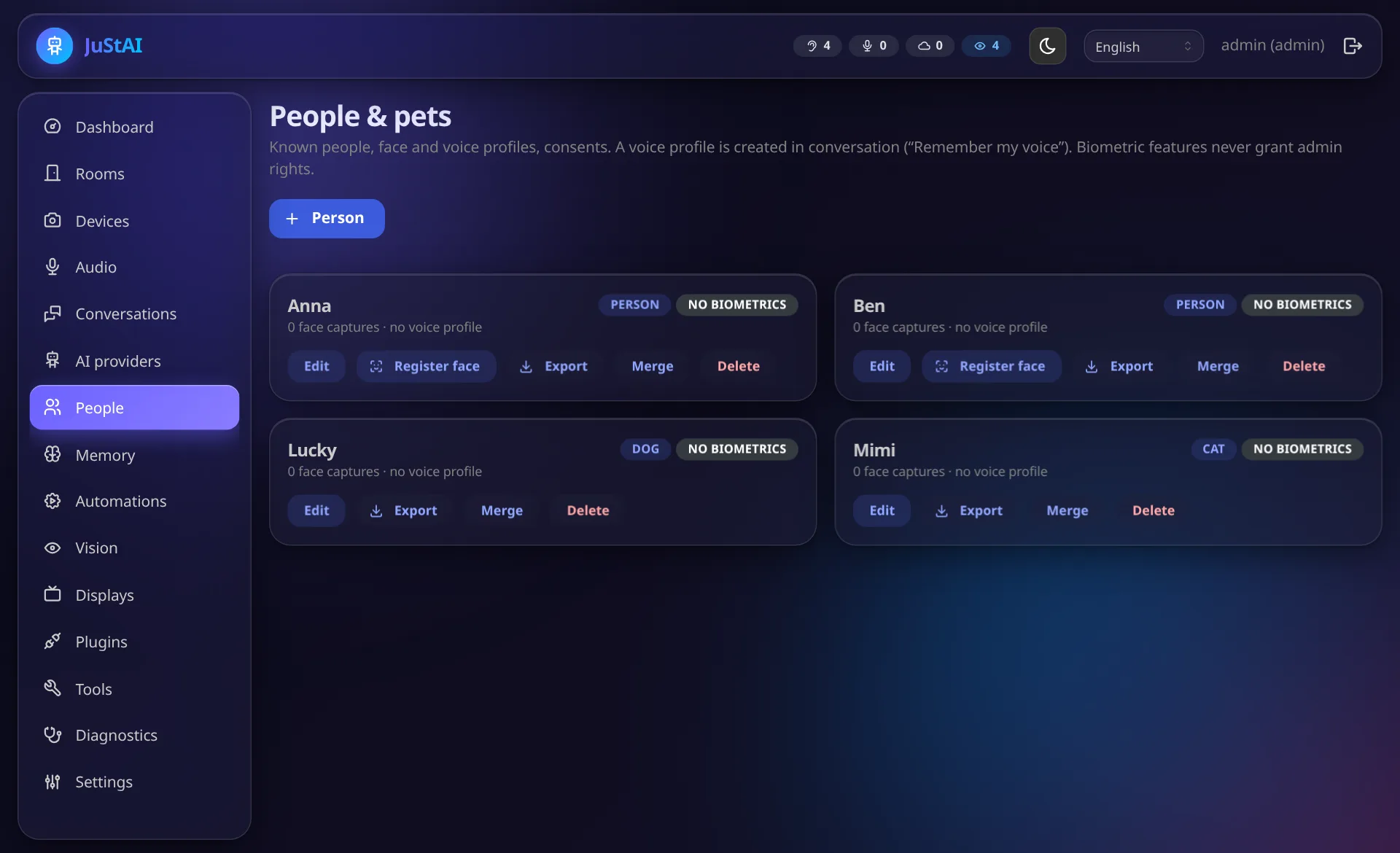
Section titled “People, pets, faces”People and pets are managed in the admin UI under People or created in conversation (“I
am Julian”, tool identity.introduce).
Biometrics only with consent.
- Face embeddings are only stored if a consent (kind
face) with evidence (who, when, how) is recorded for the person. - The tool
identity.register_facerequires an explicit spoken confirmation (requires_confirmation) and the permissionbiometric.enroll. - Registration checks the quality: face size ≥ 70 px, sharpness, frontality. Nearly identical shots are not stored twice.
- Revoking consent or deleting the person removes all biometric data (embeddings,
thumbnails). People can be exported (
GET /api/people/{id}/export) and merged.
Recognition:
- SFace cosine similarity: from 0.40 “weak”, from 0.52 “strong” (configurable in the plugin). This is not a calibrated probability and is never shown as a percentage.
- A track counts as recognised with one strong hit or two weak hits for the same person.
- Biometrics personalise (form of address, own memories) but never grant administrator
rights (
auth/rbac.py). - Pets: if there is exactly one registered animal of a species, a recognised dog or cat is assigned to this animal (an assumption, marked as such).
Voice profiles
Section titled “Voice profiles”Besides the face a person can also be recognised by voice: the face shows who is in the room, the voice who is speaking.
- Creating in conversation: “Remember my voice” (tool
identity.register_voice, confirmation required, permissionbiometric.enroll). The assistant uses what was said in this conversation (at least 4 s; otherwise it asks for a few more sentences) and stores several voice samples from it (embeddings, no recordings; max. 10 per person, the newest are kept). Consent “voice” is recorded with evidence. - Recognition: at the “Hey Justy” at the start of every conversation; if that is not enough, once more after ~3 s of speech. A name is only given with similarity ≥ 0.55 and a margin ≥ 0.08 to the next best person. The voice has priority over the camera.
- Deleting: “Forget my voice” (
identity.forget_voice), People → Delete voice profile, revoking consent or deleting the person remove all samples. Merging transfers them, export contains them. - A recognised face or voice personalises the conversation (own memories, form of address) but never gives admin rights. A voice can be imitated with a recording; it is not authentication.
Tested
Section titled “Tested”- Unit: tracker, motion, privacy mask, state classification, point in polygon
(
tests/unit/test_vision_logic.py). - With a real camera (C200): snapshots and
vision.look(Gemini, with fallback togemini-flash-lite-lateston overload). Face registration and recognition with the real camera are still pending because a person has to stand in front of the camera. - E2E:
vision.person.recognized(injected) triggers a greeting automation in the right room.