Rooms, interaction endpoints and output router
| Term | Meaning |
|---|---|
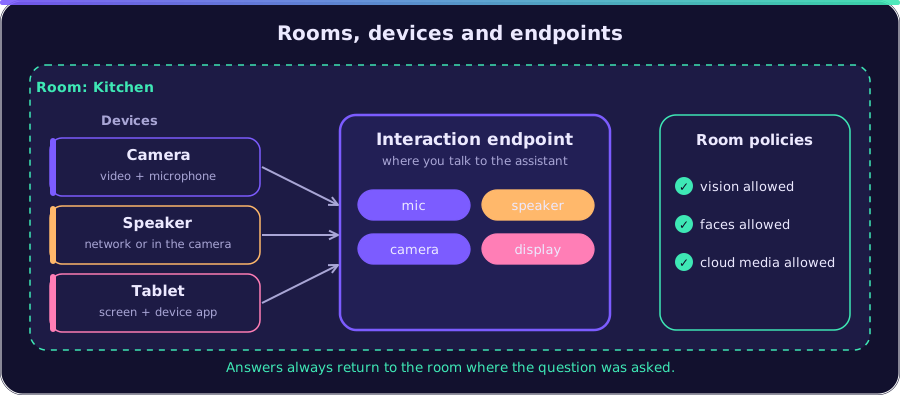
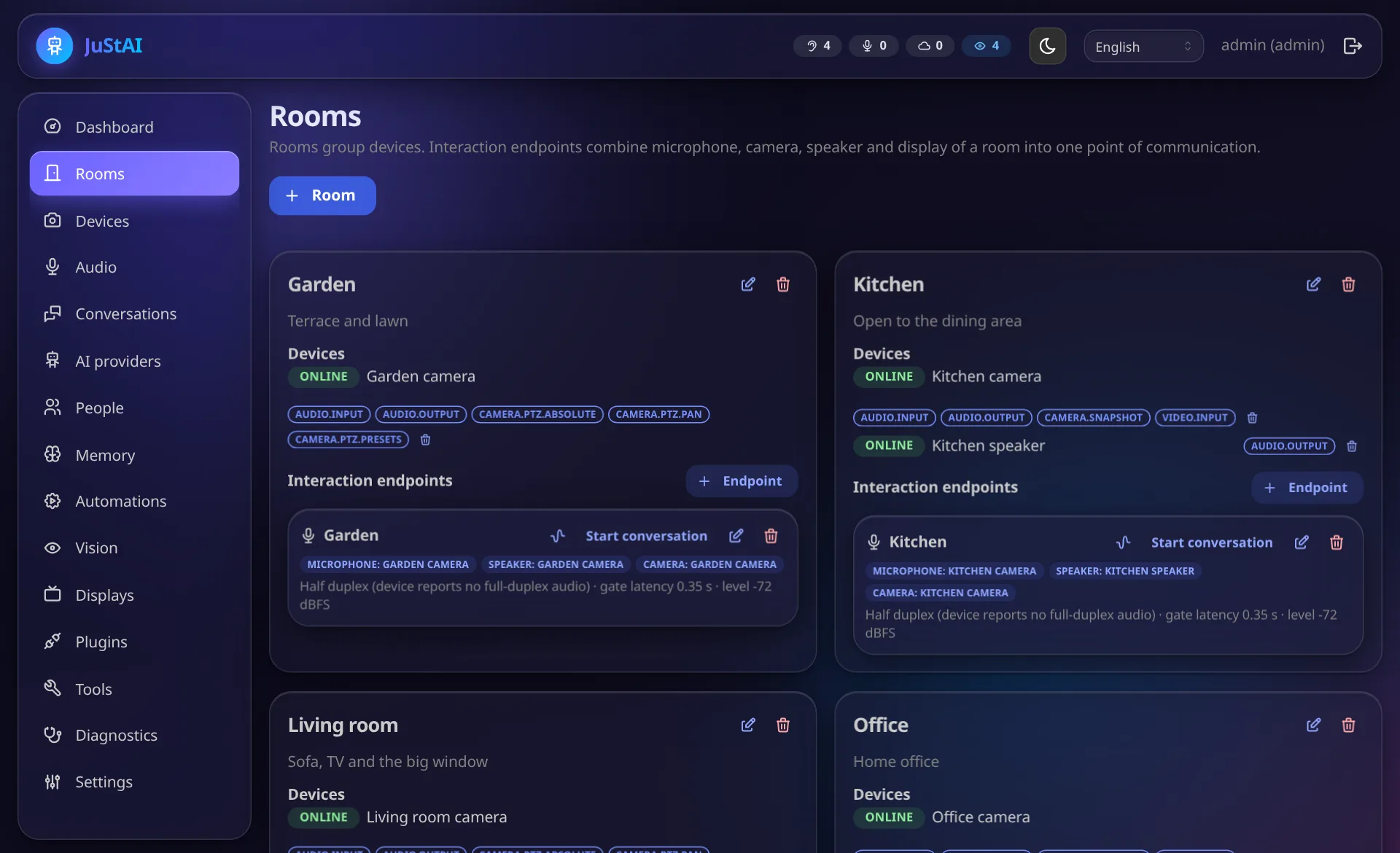
| Room | physical area (living room, kitchen). Devices and endpoints belong to exactly one room. |
| Device | camera, microphone, speaker, display … with determined capabilities (DEVICES.md) |
| Interaction endpoint | concrete place where you talk to the assistant: combines independent devices in the roles mic, speaker, camera, display |
| Arbitration group | endpoints that can hear the same wakeword at the same time (e.g. open-plan kitchen). Exactly one wins per group (AUDIO.md). |
An endpoint can for example combine the microphone of a Tapo camera, a network speaker and a TV. A device can appear in several endpoints (the microphone channel is shared).
Room policies (policy)
Section titled “Room policies (policy)”| Field | Default | Effect |
|---|---|---|
shared_space |
true | personal content is not shown on displays here |
vision_allowed |
true | cameras in this room are analysed |
face_recognition_allowed |
true | face recognition in this room |
cloud_media_allowed |
true | images/audio from this room may go to cloud AI |
announcements_allowed |
true | the room accepts announcements from other rooms |
Endpoint configuration
Section titled “Endpoint configuration”Model: backend/src/justai/endpoints/service.py.
wakeword: enabled: true # false = do not listen (also by voice: "stop listening here for an hour") models: [hey_justi] threshold: 0.8 threshold_during_playback: 0.85 # full duplex onlyaudio: duplex: auto # auto | half | full aec: true noise_suppression: true output_latency_ms: null # measured by calibration echo_tail_ms: 600 input_gain_db: 0 vad_threshold: 0.5 barge_in: true barge_in_min_speech_ms: 300conversation: mode: default # default (global setting) | realtime | pipeline inactivity_timeout_s: 10 end_of_utterance_silence_ms: 700 max_utterance_s: 30 voice: null default_role: resident # permissions of anonymous speakers at this endpoint follow_up_listening: true send_video: false # camera images to realtime providers that support it resume_window_s: 300 # a new wakeword within 5 min continues the last conversation (0 = never) speaker_check: true # ... but only if voice/camera do not point to another personContinuing conversations
Section titled “Continuing conversations”If a conversation ends through inactivity and the wakeword is heard again at the same
endpoint within resume_window_s, the assistant continues the last conversation (the
previous history is in the context). It does not continue if …
- the conversation was ended on purpose (“Bye”, admin),
- the endpoint’s camera now sees a different recognised person than before,
- the voice in the wakeword clearly does not match the voice of the last conversation.
The voice comparison uses a speaker model (WeSpeaker ResNet34). The voice fingerprints exist only in memory, are not assigned to any person and are discarded when the window expires; recorded speech is deleted right after the calculation. Measured values: same voice 0.68–0.82, other voice 0.26–0.34 (threshold 0.45; also in 8 kHz camera quality). If no comparison is possible (e.g. too little speech), the conversation continues within the window.
At the start of every conversation the assistant also takes over the person that the endpoint’s camera recognised as the only one within the last minute (“You are talking to Julian”).
Further fields: room_id, arbitration_group (default default), priority,
language, enabled.
The conversation language follows the speaker: whoever speaks Italian gets Italian
answers. language (or the default language under AI providers) is only the starting
point, e.g. for the speech recognition before the first words.
Output router
Section titled “Output router”backend/src/justai/output/router.py is the only place that decides which device
may output. The rules are deterministic and never delegated to the language model:
- Output goes to the room of the triggering interaction. The endpoint’s room has priority over any room claimed elsewhere.
- Another target room needs three things: an explicit cross-room request (only tools
like
conversation.announceset it), the permissionoutput.cross_roomand a target room withannouncements_allowed. - An explicitly requested device must be in the target room, online and have the required capability.
- Audio prefers the speaker of the triggering endpoint. The fallback is another speaker of the same room, never another room.
- Personal content does not appear on displays in
shared_spacerooms unless explicitly allowed. - Offline devices are never chosen. If nothing is available, the output fails with
RoutingDeniedinstead of silently moving to another room. - Output without an origin room (e.g. test tones from the admin UI) is only allowed for admins.
Every decision contains reasons (reasons) that are visible in the log and the
diagnosis.
Binding conversations to their room
Section titled “Binding conversations to their room”A conversation session belongs to exactly one endpoint. Every audio output of the session
(answers, tool results, confirmation questions, error notes) asks the output router with
the session’s origin_endpoint_id. This also applies:
- after long tool calls and waiting times,
- after reconnects or fallbacks of the AI provider,
- when automations start a session: room = room of the triggering event
(
room: trigger) or an explicitly configured room.
Verified by the E2E tests (backend/tests/e2e/test_simulated_rooms.py): the answer only
appears at the living room speaker, the kitchen speaker does not get a single audio
frame.
Parallel conversations
Section titled “Parallel conversations”Endpoints in different arbitration groups can have their own sessions at the same time. Every session has its own state, history and output. In the E2E test two rooms ask “2+2” and “3+3” in parallel, and each room gets its own answer.